.png)
Alcohol, Cannabis, and the Missing Conversation About Risk
I’ve been sober for nearly 30 years. My recovery has been built on abstinence, community, purpose, faith, and a lot of help from other people. I don’t use cannabis, and I don’t encourage people to use cannabis. At the same time, I’ve spent decades as a social worker working with addiction, mental illness, trauma, and families in crisis. My job isn’t to tell people what they should think. My job is to help people make informed decisions that reduce harm and improve their lives.
That distinction matters because conversations about alcohol and cannabis have become increasingly ideological. People often assume you’re either pro-cannabis or anti-cannabis, pro-legalization or anti-legalization, abstinence-only or anything-goes. Reality is more complicated.
As a clinician, I’m interested in risk. As a citizen, I’m interested in public policy. As someone in long-term recovery, I’m interested in reducing suffering. Those interests often overlap.
There has been a recent pushback against cannabis legalization, and some of it is justified. Legalization has produced unintended consequences. Higher-potency products, aggressive commercialization, and increased access deserve serious scrutiny. Not every concern raised by critics is irrational, and pretending cannabis is harmless serves no one.
What strikes me, however, is how often cannabis is discussed in isolation from alcohol, a substance that remains one of the most dangerous and destructive drugs in America.
Notice I said drug.
Not beverage.
Not lifestyle choice.
Not social lubricant.
Drug.
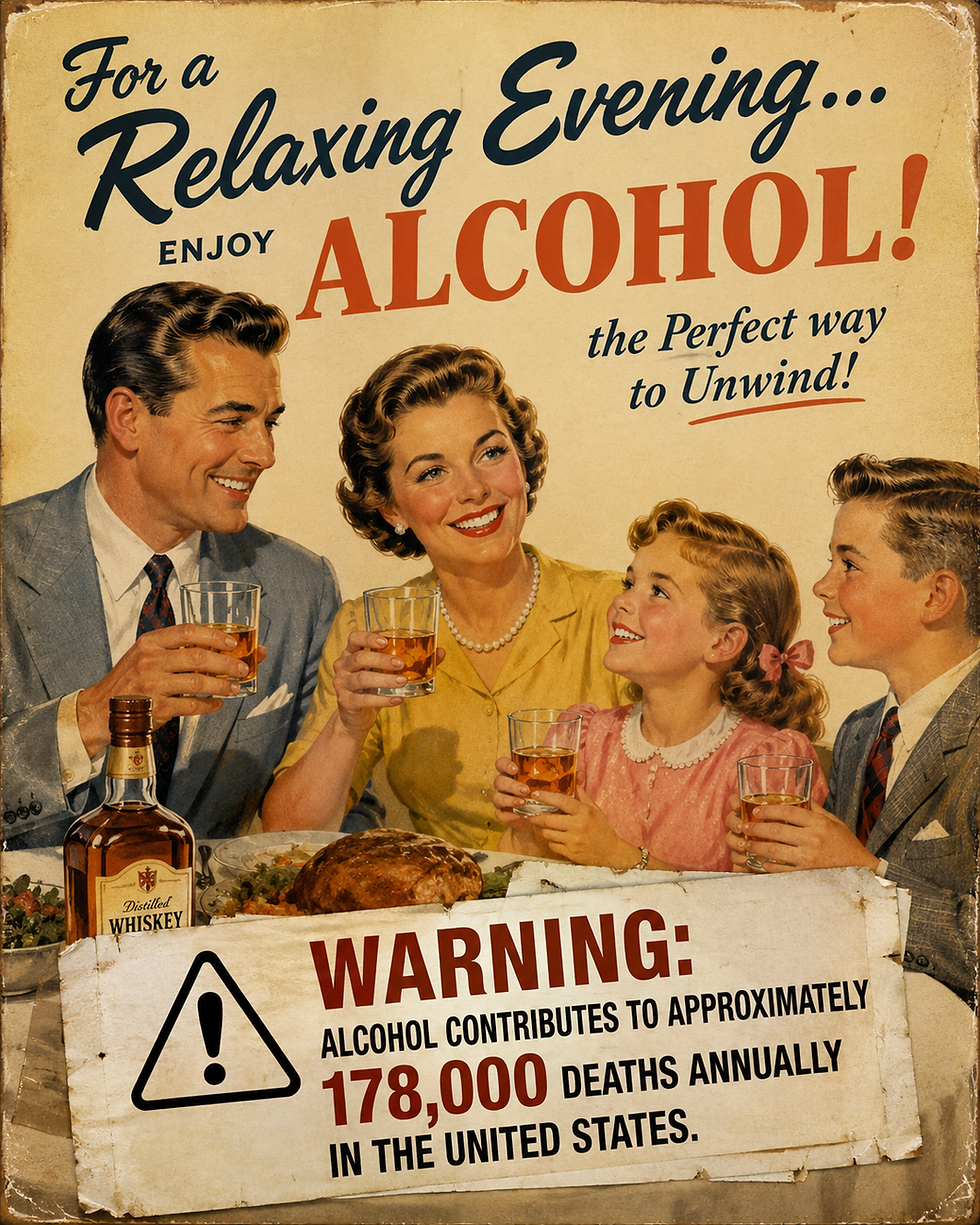
Alcohol is a psychoactive substance that contributes to approximately 178,000 deaths annually in the United States. It is associated with liver disease, cancer, cardiovascular disease, domestic violence, traffic fatalities, assaults, workplace problems, family disruption, and an astonishing amount of human misery. Yet because it is legal, culturally accepted, and deeply woven into American life, we rarely discuss it with the same urgency we reserve for other substances.
Cannabis is not harmless. Some people develop dependency. Some experience anxiety, paranoia, or worsening psychiatric symptoms. Young people should be particularly cautious. Driving while impaired is dangerous, regardless of the substance involved.
But if the question is relative risk—and that’s the question policymakers, parents, and clinicians should be asking—the comparison isn’t particularly close.
Alcohol has a well-established lethal dose. Cannabis does not.
Alcohol withdrawal can kill you. Cannabis withdrawal cannot.
Alcohol is strongly associated with violence and aggression. Cannabis is not.
Alcohol contributes to tens of thousands of traffic deaths and countless emergency room visits every year. Cannabis impairs driving and should never be used behind the wheel, but its risk profile remains substantially lower.
Alcohol is linked to multiple forms of cancer. Cannabis is not.
By virtually every meaningful public health metric, alcohol creates more death, disease, violence, and social harm than cannabis.
That doesn’t make cannabis safe.
It makes alcohol extraordinarily dangerous.
As a social worker, I’ve often found that people struggle with nuance. The moment you acknowledge the risks of cannabis, you’re accused of wanting prohibition. The moment you acknowledge that cannabis is safer than alcohol, you’re accused of being a legalization activist.
The truth is that both things can be true.
Cannabis carries risks.
Alcohol carries greater risks.
And no intoxication at all carries the least risk.
That last point is the one that often gets lost.
Whenever we discuss substances—especially with young people—we should be honest about all the options. If we’re going to discuss the risks of cannabis, we should discuss the risks of alcohol. If we’re going to discuss the risks of alcohol, we should also acknowledge that abstinence remains a perfectly reasonable and often very healthy choice.
No intoxication is always on the menu.
As someone who has been sober for nearly three decades, I can personally attest that life without alcohol or drugs is not only possible, but often preferable.
At the same time, public health requires us to engage with reality rather than wishful thinking. Not everyone is going to choose abstinence. Not everyone is going to stop using intoxicants. Good public policy accounts for that reality.
That’s one reason I support cannabis legalization.
Not because I think cannabis is harmless. Not because I think everyone should use it. I support legalization because I believe it is both better public policy and better public health.
Criminalization has a long and ugly history in the United States. It has often resulted in selective enforcement, justified racism, mass incarceration, unsafe black markets, and enormous profits for criminal organizations. It has also created a supply chain in which consumers have little idea what they’re purchasing, where it came from, how potent it is, or whether it contains contaminants.
Legalization doesn’t eliminate those problems, but it creates tools that prohibition never could: regulation, testing, age restrictions, labeling requirements, quality control, consumer education, and taxation.
I’ve always found it strange that we accept the idea of regulated alcohol, regulated tobacco, regulated pharmaceuticals, and regulated gambling, yet somehow believe cannabis should remain the exclusive domain of criminal enterprises.
I help people get off drugs for a living. I pay taxes. Why shouldn’t drug dealers?
That may sound flippant, but it’s actually a serious policy question. If a market is going to exist—and history suggests it will—should it be regulated, taxed, and monitored, or should it remain in the hands of people who don’t check IDs, don’t pay taxes, don’t test products, and don’t answer to regulators?
Reasonable people can disagree, but I know where I land.
What concerns me most is the lack of consistency in how we discuss risk.
Recently, there have been calls for stronger warning labels on cannabis products. Fine. Consumers deserve accurate information. But if we’re going to require warning labels on cannabis, intellectual honesty suggests we should do the same for alcohol.
Imagine them.
Cannabis: May impair short-term memory and increase your likelihood of staying home watching silly movies.
Alcohol: May cause rank stupidity in men under 30.
Cannabis: May increase appetite.
Alcohol: May increase confidence far beyond demonstrated ability.
Cannabis: May impair judgment.
Alcohol: May result in texting your ex, fighting your best friend, and waking up needing a lawyer.
The joke works because there’s truth underneath it.
We have spent generations treating alcohol as the normal baseline and every other intoxicant as the exception. The data suggest we should be asking harder questions.
As a sober guy, I don’t recommend alcohol. I don’t recommend cannabis. If someone asks me what is safest, the answer is easy: neither.
But if we’re going to have an honest conversation about risk, public health, and public policy, we need to stop pretending alcohol is somehow different from every other psychoactive substance.
It’s not.
It’s one of the most dangerous drugs in America.
We’ve simply gotten used to it.


Comments